



2027 Speaker Lineup

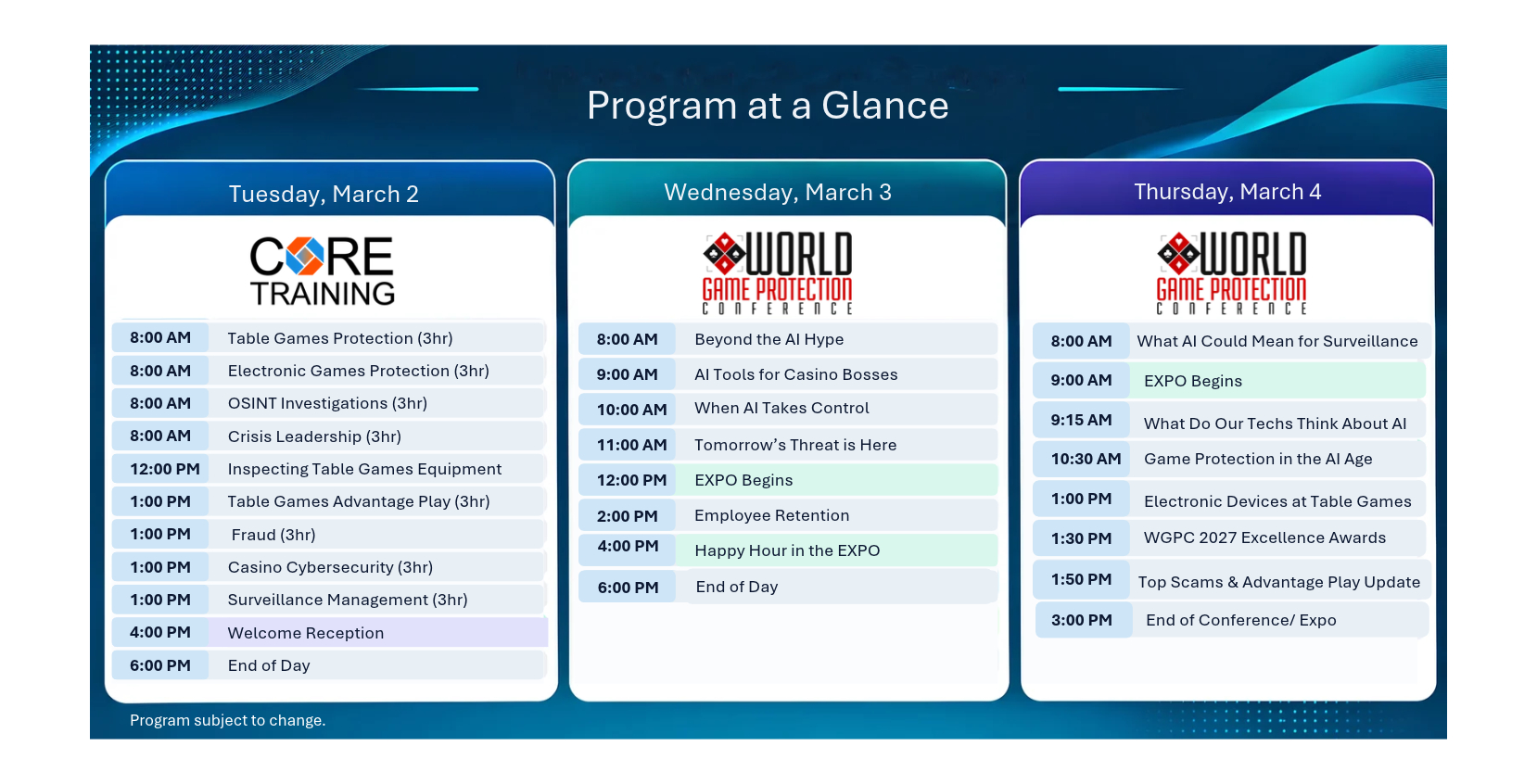
Full Program and Session Descriptions
Overview
This newly revised and updated seminar delivers targeted, real-world strategies to protect your table games from modern cheating and theft. Led by a veteran casino surveillance professional, this session cuts through the noise to focus on the immediate threats facing today’s gaming floors.
Module 1: Player Trickery
A focus on the outside threat. What to look for and how to protect against past posting, card switching, card mucking and card marking.
Module 2: Dealer Collusion
A focus on the inside threat. What to look for and how to protect against dumping the game, turning a blind eye, false shuffle sequence setups, concealed camera sequence recording and pre-game sequence recording.
Module 3: Security of Equipment
A focus on gaming equipment and cheating devices. What to look for and how to protect against chip thefts, fake chips, wheel and dice exploitation, rigged auxiliary gaming equipment and the latest cheating devices to be concerned about.
- Speakers:
- Willy Allison
Overview
Electronic gaming machines represent 75% – 85% of all casino gaming revenue in the US and often cover a majority of the casino floor. In this CORE seminar students will learn common areas of vulnerability that can be exploited by fraudsters and how best to protect against machine scammers.
Module 1: The Nuts and Bolts of Electronic Games
Learn the basics of how gaming machines work and why they are networked. Gain a better understanding of where vulnerabilities can occur.
Module 2: Slot Machine Cheating and Fraud
Examine the common, not so common and game-changing scams that have taken place on slot machines over the years.
Module 3: Today’s Hot Spots for Shenanigans
Get up to date with slot advantage play techniques, player club scams and exploiting the new electronic table games.
- Speakers:
- Darrin Hoke
Overview
Master essential open source intelligence (OSINT) and advanced search techniques in this two-module seminar. Participants will learn investigative terminology, navigate social media platforms using a hands-on case study, and utilize expert Google and search engine strategies to uncover deep web content and streamline online investigations. Please note: Bringing a laptop to class is preferred but is not a requirement of attendance.
Module 1: Online Investigations and Open Source Primer
Every investigation involves, at some level, social media, and open source examinations. This introductory module examines the different types of open source and social media platforms and the language of this unique investigative world. In this introductory hands-on course, participants will learn the types, differences, and jargon of open source investigations. During the training, you will conduct open source research, driven by a case study. Upon completion, participants will be able to navigate the Internet and social media platforms for rudimentary online investigations as well as use time and resources more efficiently.
Module 2: Utilizing Advanced Google Searches
The ability to uncover information on the Internet is the primary skill of an investigator. The go-to resource for many is Google, yet not everyone knows how to utilize its full potential. This class expands your general knowledge of the search engine, making difficult searches more effective. In this intermediate to advanced hands-on class, participants will learn how to maximize Google searches, as we cover the basics, the hacks, and extra Google resources to create proper search strategies and run advanced Internet searches. Participants will also learn the expert tools of this common search application to make difficult searches more effective. Upon completion, participants will be able to hunt down deep web content, conduct advanced search strategies on Google, Bing, and other search engines, and use algorithms for surface finds and open source results.
- Speakers:
- Megan Munoz
Overview
The House Always Wins…Unless the Power Goes Out
Is your organization ready for the day the house doesn’t win? Every casino runs on the promise that the show never stops — the dealers keep dealing, the reels keep spinning, and the cameras never blink. But when a crisis hits, that promise is only as strong as the plan behind it. Statistics show most organizations will face some form of crisis at least every 5 years, and Covid taught us the hard lesson that we don’t get to choose when the tables go dark.
The good news: how we respond is entirely within our control. This interactive session deals out 3 modules that will give leaders a strong crisis management foundation to build resilience across their organisations. Running through it all is a theme on the human behaviours that separate the winners from the busts when the chips are down. Winning is a team sport.
Module 1: Know the House Rules
Every game has rules, and crisis management is no different. Participants will be exposed to the crisis lifecycle, terminology, crisis management team (CMT) composition, hierarchical response, and initial CMT priorities. This will evolve into the actual roll-up-the-sleeves processes required to play the hand well when a real crisis lands.
Module 2: Reading the Table
Case studies and real crisis scenarios from the speaker’s past will be reviewed to highlight common pitfalls in crisis management execution — the tells that gave the crisis away and the moments the house nearly lost control. The discussion will also cover the importance of the after-action process in driving continual learning.
Module 3: The Blackout — Practical Exercise
The lights go out. The floor goes dark. Participants will be broken into groups and collaboratively work through a guided crisis scenario built around a full power outage on a live casino floor at peak hours — no lighting, no cameras, no point-of-sale, and a floor full of guests. This immersive exercise leverages the learnings of the first two modules and culminates in a group discussion on what it takes to keep the operation — and the organization — standing when the power doesn’t.
- Speakers:
- Rob Currie
Modern casino operations rely heavily on the integrity of table games equipment to maintain the house edge, protect the bankroll, and ensure regulatory compliance. However, subtle equipment defects—whether caused by structural wear, manufacturer anomalies, or sophisticated physical manipulation—can silently compromise game security. This session provides casino surveillance professionals, table games managers, and game protection specialists with a comprehensive framework for executing rigorous, systematic inspections of critical gaming assets.
Attendees will examine practical methodologies for evaluating the structural integrity of dice, playing cards, roulette wheels, and electronic shuffling systems. Through real-world case studies of equipment vulnerabilities, the presentation will demonstrate how to detect microscopic flaws, asymmetrical biases, and unauthorized alterations. Participants will leave with actionable checklists, standardized testing protocols, and a proactive strategy to integrate routine technical auditing into daily surveillance and floor operations.
- Speakers:
- George Joseph
Overview
This revised and updated seminar focuses specifically on identifying legal advantage play opportunities for casino table games. Participants will explore legitimate strategies used to gain a mathematical edge over the house, distinct from illegal cheating..
Module 1: Predictive Analysis
A focus on card tracking techniques. What to look for and how to protect against card counting, side bet counting, shuffle tracking and beating shuffle machines.
Module 2: Card Knowledge
A focus on the advantage gained by identifying cards before they are revealed in the game. What to look for and how to protect against hole carding blackjack, hole carding other games, first card advantage, location plays and players sharing card information on the table during the game.
Module 3: Exploiting Equipment
A focus on techniques used by players to exploit gaming equipment. What to look for and how to protect against edge sorting, imperfect cards, flawed wheels and dice manipulation. At the end of this module Bill Zender will hold a 10 minute “ask me anything” Q & A session.
- Speakers:
- Bill Zender
Overview
Casinos invest millions in world-class surveillance, fortified cages, and enterprise firewalls, yet organized criminal networks are bypassing all of it without writing a single line of malicious code. Instead of hacking the system, they hack the human. Drawing directly from real-world cybercrime and fraud investigations, this course pulls back the curtain on how modern threat actors weaponize psychology and digital convenience to compromise gaming operations. Participants will learn the exact playbooks syndicates use to manipulate frontline staff, exploit mobile apps, and drain patron accounts, equipping gaming leaders and security teams with practical strategies to disrupt the scam lifecycle.
Module 1: Social Engineering and Hacking the Human
Before a single system is breached or a dollar is stolen, bad actors target the most vulnerable part of any security ecosystem: human psychology. This module breaks down the foundational anatomy of a scam—Hook, Story, Urgency, and Payment—and reveals how criminals use psychological weapons like authority, fear, and artificial urgency to hijack critical thinking. Participants will see how fraudsters conduct reconnaissance and manipulate trusted casino employees into handing over sensitive information and bypassing established protocols.
Module 2: Digital Apps, Identity Theft, and Loyalty Programs
As gaming rapidly transitions into a cashless, mobile-driven age, street-level scammers have evolved into sophisticated cyber syndicates. In this module, participants will examine how threat actors exploit mobile wagering platforms, digital wallets, and player loyalty programs to steal from both the house and its patrons. Discussions will cover the investigative reality of synthetic identities, credit card funding fraud, and Account Takeover (ATO) schemes targeting high-tier loyalty comps, alongside the controls needed to stop them.
Module 3: Case Studies — Letting Money Walk Out the Front Door
The final module steps straight into the detective’s case files, deconstructing actual investigations where casinos and cage employees were systematically manipulated into letting hundreds of thousands of dollars literally walk out the front door. By tracing the anatomy of high-stakes executive impersonation heists, participants will uncover how organized rings maintain prolonged psychological control over staff, how stolen cash is rapidly laundered through cryptocurrency kiosks, and what operational guardrails must be in place so your property isn’t the next headline.
- Speakers:
- Marc Evans
Overview
As the gaming industry faces a rapidly evolving landscape of cyber threats, it’s essential for executives to cultivate a strategic approach to cybersecurity. This course is designed to elevate leaders’ understanding of key cyber risks and equip them with the insights needed to build an effective, resilient cybersecurity strategy. Through focused discussions and case studies, participants will gain awareness of the critical elements in cyber defense, emphasizing strategy over tactics.
Module 1: Understanding Online Threats
This module introduces executives to the core threats affecting the casino industry,including social engineering, insider threats, OSINT, and the influence of the dark web. Through real-world case studies, leaders will gain a high-level view of how these threats impact organizations and the importance of a proactive, strategic response.
Module 2: Building a Cybersecurity Strategy
In this module, participants will explore foundational elements of a cybersecurity strategy, including risk assessments, policy development, and resource allocation. The focus will be on building a robust framework that supports risk-informed decision-making. Topics will also cover the role of incident response planning and exercises, budgeting, training programs, as well as strategies for managing vendor-related risks.
Module 3: Advanced Strategic Considerations
The final module addresses privacy management, data protection, breaches, and the role of deception and disinformation techniques in a holistic security strategy. Through examples of high-level protection strategies, participants will learn to prioritize cybersecurity initiatives that align with the organization’s objectives and risk tolerance.
- Speakers:
- Mishaal Khan
Overview
A knowledgeable surveillance professional with strong leadership skills and the ability to manage an efficient high-performance department is an asset to any casino organization. But how does one become a good Surveillance Director? How do you set up a surveillance operation that casino executives cannot only rely on but brag about? This class is taught by 39-year casino surveillance veteran Willy Allison who breaks down his Four Pillars of Surveillance: People, Operations, Communication and Information.
Module 1: Creating a Great Team
The most important component of a great surveillance operation is people. In this module the following topics will be covered: Leadership, Clearly Defined Objectives, Recruitment, Training and Performance Management.
Module 2: Building a House
The monitor room is the home of surveillance professionals. Setting your house up with solid foundations in the beginning can save a lot of problems down the line but more importantly it should make people feel comfortable and give them the tools to perform their job. In this module the following topics will be covered: CCTV Design, Monitor Room and Amenities, Operating Procedures, Quality Assurance, Labor Efficiency, Reporting Systems and Player Analysis Systems.
Module 3: Proactive Produces
There’s been a lot spoken about what is “proactive.” Willy doesn’t think proactive is about taking a lifesaver tower approach. He believes proactive is about getting quality information and intel, clear and concise customer and employee communication and building trusting and respectful relationships with partners who share the same objectives. In this module the following topics will be covered: Electronic Alerts, Gaming Data, Staff and Customer Information, Customer and Staff Communication, Regulators, Networks, Vendors and Suppliers.
- Speakers:
- Willy Allison
Open to WGPC delegates, speakers, sponsors, and registered exhibitors, the welcome reception is a can’t-miss tradition and the perfect opportunity to reconnect with colleagues and make new connections.
To celebrate our milestone 20th show, we’re excited to present a special performance by Keelan Leyser, the internationally acclaimed technology magician and star of the Las Vegas show HACKED.
Wear your favorite sports team’s jersey, spark a conversation and proudly show off your team loyalty – it’s a great way to break the ice! Light snacks and refreshing drinks will be served.
Don’t forget to wear your WGPC badge for easy entry!
- Speakers:
- Keelan Leyser
Artificial Intelligence dominates the headlines–and it’s clear we’re in the middle of a major hype cycle. But beneath the buzz, genuine innovations are delivering tangible value. So what’s real, what’s exaggerated, and what’s next?
Join Richard Campbell for an insightful look at the current AI surge, why it matters, and where the real success stories are happening today. Explore the opportunities, the challenges, and the eventual end of the hype cycle—so you can separate the promise from the noise and prepare for the future of AI in business and development.
- Speakers:
- Richard Campbell
Casino Leaders make fast decisions while juggling shift handovers, staff training, incident follow-ups, and daily reports. In this live session, Rider Harris shows what AI is, and what it is not. How tools like ChatGPT, Claude, and Microsoft Copilot can help turn approved notes into clear handover summaries, build training guides from existing procedures, and draft concise briefings for management.
Attendees will learn a repeatable prompting method, see how to check AI output, and know when sensitive guest, employee, or security information must stay out of public tools. They will leave with practical workflows they can adapt to their own operations the next morning. No technical background is needed.
- Speakers:
- Rider Harris
AI is moving from answering our questions to acting on our behalf. As AI agents take on business tasks, the stakes rise: a misunderstanding, a malicious instruction, or too much access can turn a useful capability into an operational risk.
This keynote examines how organizations can anticipate those risks and maintain control over the actions AI agents take. It connects risk assessment with practical decisions about access, oversight, and accountability: what to assess, where human approval matters, and how to detect and contain unintended actions. The focus is on approaches organizations can apply as they evaluate, adopt, or expand their use of AI agents.
- Speakers:
- Helen Oakley
This presentation looks at a new type of attacker: one whose attack tools are implanted in the body. Subdermal microchip implants can be used as covert attack platforms. They carry no external hardware and cannot be found by physical inspection. The session includes live demonstrations of five transhuman attack vectors, showing how implanted technology can be used to phish, clone credentials, pivot and exfiltrate data. Each attack gets past traditional physical and technical controls.
The presentation then looks at how artificial intelligence and wearable technology are changing the threat landscape for the casino and gaming industry. Smart glasses, earbuds, rings and other connected devices can now calculate, record and relay information in real time. They also look just like everyday consumer electronics. This makes it much harder to detect and prevent cheating and advantage play.
The final section covers the legal and regulatory side of the problem. Health, disability and biometric privacy laws protect implanted and medical devices and the data tied to them. These laws also limit what operators can ask about, inspect or restrict, so the protections designed for the public can end up protecting criminals. The session closes with practical recommendations for security, surveillance and compliance teams so they can respond to these threats within current legal limits.
- Speakers:
- Len Noe
Today employees are looking for leadership that supports, encourages, and gives them the tools they need to grow, adapt, give back – and create real impact. In this unforgettable customized presentation designed to inspire corporate leadership and managers, Clint expertly demonstrates the ground-breaking WHY of mentorship over old school management techniques and HOW every employee is just one caring person away from a phenomenal success story.
As a Corporate Keynote Speaker and retention expert, Clint offers the insider leadership secrets for elevating team and individual engagement, cultivating creative and collaborative environments, and inspiring both themselves and those that they lead. He also shares the life-changing story of Mr. Jensen, who, with one small and simple gift, brought purpose, empowerment, and perspective to a young life – and how each of us has the chance to do the same.
In this powerfully moving session, audience members will be able to:
• Adapt to a rapidly changing workforce.
• Communicate effectively with a multi-generation team.
• Create a culture that cultivates, celebrates, and encourages diversity.
• Understand the four keys to mentorship within the role of leadership.
• Develop a greater understanding of their purpose as a leader and mentor.
• Adopt implementation strategies of how to create cultural change.
Ready to transform your leadership? Award-winning speaker Clint Pulver will teach how Mentorship vs Management reaffirms, validates, and inspires your leadership and management team, teaching them how these simple shifts can create inspired and lasting impact on their lives, their teams, and your organization.
- Speakers:
- Clint Pulver
Mix, mingle, and meet! Join us in the EXPO for Happy Hour, a relaxed opportunity to meet other attendees, speakers, and exhibitors. Walk the floor, visit booths, and connect with product experts—all while enjoying a refreshing beverage.
SURVEILLANCE TECHNOLOGY SYMPOSIUM – Conversation 1: Moderated by Willy Allison
We have the data. We have the knowledge. We have the video. And now we have AI. In this conversation we explore how AI and computer vision could, and is, making a difference to surveillance operational efficiency. AI has the potential to improve games protection effectiveness and the every day running of a surveillance operation, but in these early stages of development what do we need to consider to get the biggest bang for buck.
The panel will discuss the pros and cons of AI-powered surveillance including how do we balance human oversight with high-tech alerts? We ask the panel and audience a critical question: If you had a computer vision “wishlist” what would be the number one thing you’d want that would have the greatest impact for your department and organization?
- Speakers:
- Maria Chadwick
- Vangelis Paralis
- Scott Easton
- Jessie Beaudoin
- Willy Allison
SURVEILLANCE TECHNOLOGY SYMPOSIUM – Conversation 2: Moderated by Darrin Hoke
AI and computer vision technology all sounds good but what are the technical challenges to make it happen? What is going to be needed to integrate the technology into current systems.
In this conversation we gather the boots on the ground technical experts who are ultimately responsible for overseeing the installation of new technology and continued management of the CCTV system. What are the technical challenges and hidden costs? What’s hype and what’s reality right now? How do we evaluate tech vendors and avoid black box algorithms that cannot standup to regulatory audit? What sort of guardrails should be considered to ensure efficient and continuous operation. Ultimately, how do we best ensure compliance and the security of our CCTV systems.
- Speakers:
- Michael Saville
- Tracy Tye
- Jason Woodward
- Daniel Vincent
- Darrin Hoke
SURVEILLANCE TECHNOLOGY SYMPOSIUM – Conversation 3: Moderated by Willy Allison
A lot has changed in the last 20 years. The games are changing. Technology is changing. People’s mindsets are changing. From a game protection perspective “sleight of hand” has given way to “sleight of finger.”
In this conversation game protection leaders talk about the biggest changes they have seen on the gaming floor in the last 20 years and discuss the current threat landscape, including the evolution of the advantage play team, electronic device threats and dealer-employee collusion trends. Are we prepared for the future? Are the biggest threats external or internal? What should we change, what should we keep the same? We ask the panel and audience two critical questions: What are the main threats to the casino floor today and what do we need to do to modernize the game protection playbook to combat those threats?
- Speakers:
- Heath Irving
- Jeff Murphy
- Greg Schaaf
- Brian Zinke
- Willy Allison
A 30-minute presentation by Willy Allison examining and assessing the game protection risk of allowing smart glasses and electronic devices on table games.
- Speakers:
- Willy Allison
The presentation of the Excellence in Casino Surveillance and Lifetime Achievement Awards
In this interactive session Willy Allison and Bill Zender discuss the cheating busts that made the news around the world (they’ll also talk about some that didn’t make the news). They will break down and analyze how the scams work and with the help of the audience rank them in terms of impact and ingenuity. The hosts will also examine what types of scams are trending. What do the 2026 scams have in common? What should casinos do to sharpen their defenses against scammers in 2027? This year we’ve added an Advantage Play Update featuring ex-advantage player Andrew Uyal.
- Speakers:
- Willy Allison
- Bill Zender
- Andrew Uyal
EXPO
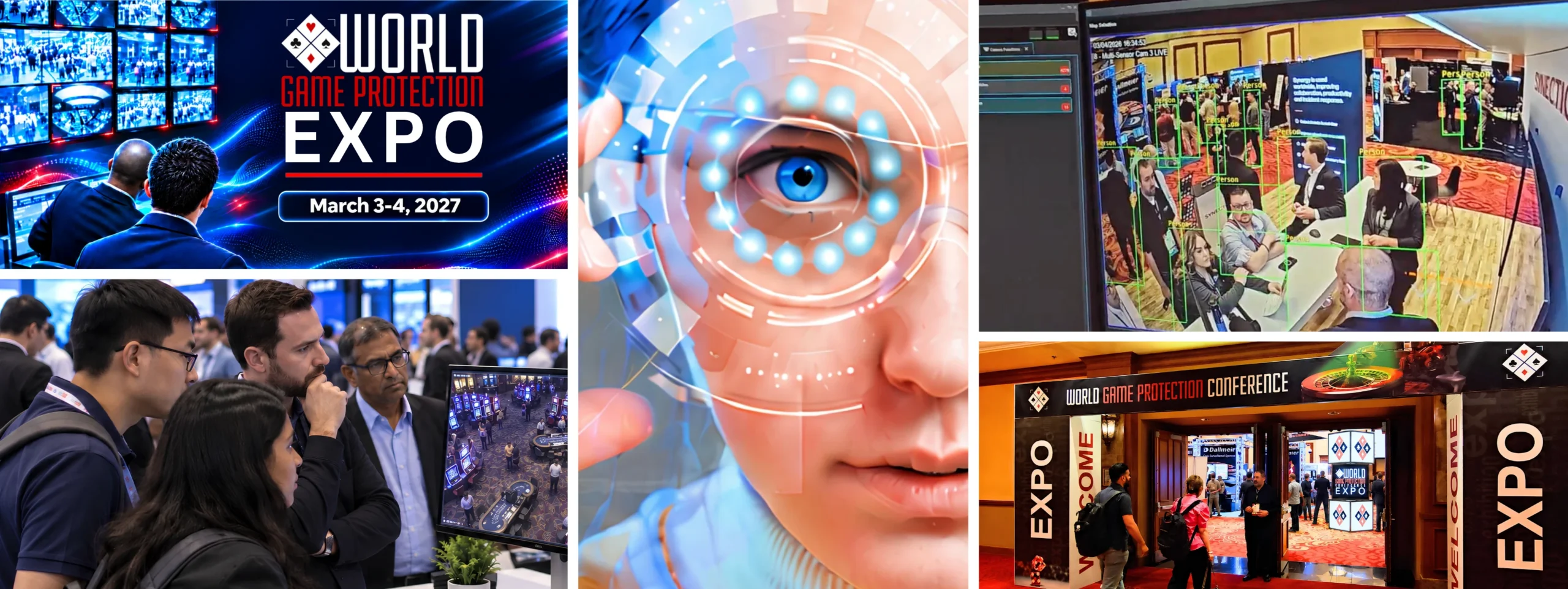
Held over two days of the World Game Protection Conference, the EXPO connects casino professionals with leading providers of surveillance, table games protection, security technology and industry solutions.
Alongside our educational program, WGPC attendees have the opportunity to see new technologies firsthand and connect with fellow end-users and industry experts – all in one place.
If you’re a manufacturer with a quality product that can provide protection or deliver a valuable intel solution for casinos, we invite you to exhibit and show us what you’ve got. Whether you’re launching a new product, entering new markets or strengthening your industry presence, the WGPC EXPO is the place to be!

2027 Sponsors and Exhibitors




















Venue

Subscribe to our newsletter
The Monitor Room is a free weekly e-newsletter designed to raise awareness to casino operational threats, covering casino news reports and issues from around the world.
SUBSCRIBE
WGPC Memories (2006-2026)
Some of Our Past Speakers
- STEVE FORTE
- ED THORP
- KEVIN MITNICK
- DON JOHNSON
- ARNOLD SNYDER
- RICHARD TURNER
- BILL ZENDER
- ABE DAVIS
- PAMELA MYER
- PERSI DIACONIS
- JOE NAVARRO
- EVY POUMPOURAS
- MICHAEL FRANZESE
- LARRY BARTON
- JEFF JONAS
- SAL PIACENTE
- R. PAUL WILSON
- KEVIN KELLY
- JEFFREY ROBINSON
- MICHAEL SHACKLEFORD
- JAYSON E. STREET
- LEROY CHIAO
- COLIN JONES
- ADAM KURCHARSKI
- MIKE APONTE
- JASON ENGLAND
- BO BERNHARD
- DUSTIN MARKS
- BOB ARNO
- MICHAEL BAZZELL
- MIKE HOWARD
- STAN WALTERS
- ART BENJAMIN
- BOB NERSESIAN
- ELIOT JACOBSON
- NORMAN BECK
- PETER LISTON
- NELSON DELLIS
- GEORGE JOSEPH
- MICHAEL BARNETT
- DREW PORTER
- TERRY ROSES
- MOHAN SRIVASTAVA
- AVI RUBEN
- JAMES TAYLOR
- MICHAEL KAPLAN
- MAC SEGAL
- JAMES GALEA
- JOSH DAVIS
- MARIA KONNIKOVA
- MICHAEL SMALL
- STEVEN BRIDGES
- TERRY RICH
- HOUSTON CURTIS
- MICHELE ALBO
- DEBI NUTTON
- EARLE G. HALL
- MISHAAL KHAN
- SHAWNEE DELANEY
- DAN LOHRMANN
- ANTHONY CABOT
- CHRISTOPHER HADNAGY
- ERIN WEST
- CHRISTIAN HUNT
- CHASE CUNNINGHAM
- ROGER GRIMES
- CRAIG SILVERMAN
- JEREMY TAN
